Conceptual Designing 'Duo Trek': A Social, Habit‑Forming Adventure for Duolingo
- Smital Kamdi
- Aug 14, 2025
- 4 min read

Updated: Oct 6, 2025
Problem statement:
How might Duolingo encourage learners to form and maintain a daily habit without guilt or friction across cultures, devices, and proficiency levels?
Proposed solution:
Duo Trek, a lightweight, map‑based, cooperative adventure layered on top of Duolingo’s existing streaks and XP. Learners “hike” iconic routes (Everest Base Camp, Swiss Alps, Inca Trail). Each day’s lesson advances their avatar, inactivity drains “energy,” and friends can send boosts or hints to help teammates re‑engage. The experience turns solo streaks into a shared journey powered by accountability, progress visibility, and playful regional challenges.
North Star:
Increase 7‑ and 30‑day retention for new and casual learners by building a sticky, social routine that feels fun, not obligatory.

Context & product principles:
Mission fit: Make world‑class education universally available; keep it light, playful, and accessible.
What works today: Streaks, XP, leaderboards, short sessions, witty mascot personality.
Gaps to close: New users’ fragile habits, drop‑offs after a missed day, limited positive social pressure, repetitive feel for mid‑journey learners.
Designing for:
New learners (D0–D7): high enthusiasm, low habit strength.
Casual/intermittent learners (D7+): motivated but inconsistent.
Lapsed learners (inactive ≥7 days): need gentle re‑entry.
Prioritize 1 & 2 for outsized long‑term retention impact.
Jobs to be done (JTBD):
When I’m trying to build a routine, help me show up daily with low effort and a sense of progress.
When I miss a day, help me restart without shame, ideally with a nudge from friends.
When I get bored, help me feel novelty and purpose tied to my learning goals.
Insight synthesis:
Visual progress > abstract numbers. A map you move along is more visceral than XP alone.
Prosocial pressure > competition alone. People return for teammates, not just trophies.
Narrative micro‑variety reduces fatigue. Regional themes create fresh micro‑rewards.
Solution overview: Duo Trek
A cooperative, region‑themed trek that translates daily lessons into steps along a route. You can go solo or with a small group; energy depletes with inactivity; friends can send boosts or share hints to help you catch up.
Core loop (daily):
Choose a trek (e.g., Swiss Alps, Mt Everest).
Complete a lesson → advance on the map + earn daily energy.
See teammates’ positions; if someone lags, send a boost (earned by finishing your own lesson).
If inactive, energy drains; to move again, complete a catch‑up quest (short burst set) or receive enough boosts to re‑spark.
Social mechanics:
Group size: 4–7 learners (auto‑matched by pace/timezone or friend‑formed).
Boosts: Light, earned help, e.g., “Trail Mix” that restores part of a teammate’s energy.
Hints: Short, playful messages or region trivia; optional reply/ignore keeps it low-pressure.
Collective milestones: Camps/checkpoints require most members to have arrived to unlock a campfire challenge (co‑op mini quiz for bonus XP).
Thematic novelty:
Region‑native moments: Micro‑lessons align with trek theme (signage vocab, local phrases, cultural tidbits).
Rotating routes: New treks monthly/seasonally to prevent content fatigue and create FOMO.
Cosmetics: Badges, patches, and Duo‑as‑Guide flair on profile upon completion.
UX sketch :
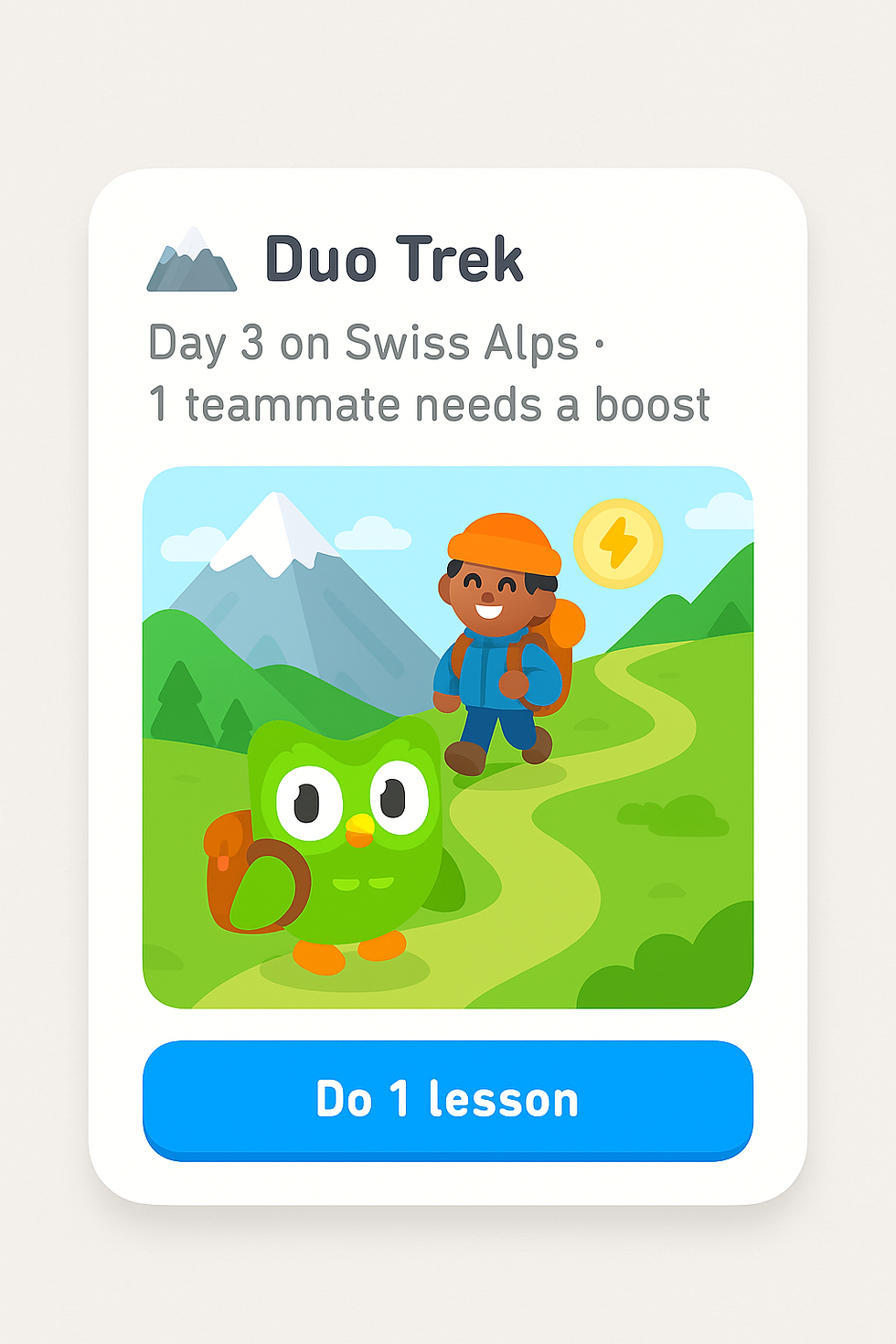
Home card: “⛰️ Duo Trek — Day 3 on Swiss Alps • 1 teammate needs a boost” → CTA: Do 1 lesson
Map view: Your avatar + teammates’ avatars along a dotted path; upcoming camp shown.

Energy meter: Full (green) after daily lesson; partial after time away; empty pauses movement.

Boost drawer: “Send Trail Mix to Maya? You can earn 1 boost today.”

Catch‑up quest: 3 mini tasks (listen, translate, speak) ≈ 2–3 minutes total.

Onboarding & activation:
Invite during week 1: After lesson #3, suggest the shortest trek (5–7 days).
Auto‑match fallback: If no friends available, match with learners of similar pace & timezone.
Frictionless join: No new currency; reuses XP/Streak and existing notifications.
Safety valves: “Quiet mode” for solo play; “Pause” aligned with Streak Freeze.
Behavioral design choices:
Make the right thing easy: 1 daily lesson meaningfully moves you forward.
Reduce shame: Energy mechanic is neutral; boosts are upbeat (“Have some trail mix!”).
Create micro‑wins: Camps/checkpoints every ~2–3 days; small badges stack into a patch set.
Prosocial defaults: Prompt to help others immediately after you complete your lesson.
Success metrics & targets (first 90 days)
Primary
D7 retention: +3–5% (new learners in Trek vs. control)
D30 retention: +2–4% (casual learners)
Avg. streak length: +10–15%
Secondary
Trek opt‑in rate
Trek completion rate, boosts sent/received per DAU
Catch‑up quest completion, notification open→lesson start conversion.
Guardrails
No increase in daily time‑on‑task beyond +60–90 seconds median (keep it lightweight).
No uplift in opt‑out or notification disable rates.
Experiment plan (MVP → scale)
MVP (4–6 weeks build)
1 short trek (5–7 days), small‑group auto‑match, basic map, energy/boosts, catch‑up quest, one cooperative camp challenge, minimal badges.
A/B tests
Social vs. solo default: Auto‑match on vs. manual opt‑in.
Boost salience: Post‑lesson prompt vs. passive drawer.
Catch‑up friction: 2 vs. 3 mini tasks; time‑boxed vs. flexible.
Checkpoint cadence: Camp every 2 vs. 3 days.
Notification tone: Mascot‑forward witty copy vs. neutral reminder.
Ramp plan
Locale pilot in 2–3 languages → 10% global → 50% → 100%, contingent on guardrails.
Content & personalisation:
Adaptive difficulty: Catch‑up quests reflect the user’s weak skills.
Route selection: Suggest trek lengths based on observed session time (shorter for under‑3‑min learners).
Timezone‑aware leagues: Syncs daily cadence to maximize overlap and live boosts.
Risks & mitigations:
Social pressure/anxiety: Solo mode, silent participation, and weekly “pause.”
Ghost teammates: Auto‑replacement after 3 inactive days; “camp skip” if majority ready.
Over‑gamification: Cosmetic rewards only; keep core lesson integrity intact.
Content fatigue: Rotate routes monthly; seasonal themes; creator pipeline for region trivia.
Accessibility & localization:
Low‑bandwidth maps (vector/emoji‑style); screen‑reader labels for all map elements.
Color‑blind safe energy states; haptic cues for progress.
Copy localised with cultural sensitivity; humor tested per locale.
Privacy & safety:
No open chat; hints are templated, rate‑limited nudges.
Report/mute tools inherit from existing social features.
Minimal surface of personal data shows avatars/usernames only.
What this achieves:
Duo Trek reframes daily lessons as steps on a shared journey. It pairs clear visual progress with friendly social accountability, giving learners multiple gentle ways to return after lapses. It’s thematically rich, technically lightweight (builds on streaks/XP/notifications), and respects Duolingo’s playful, global brand.
Appendix: PRD snapshot (abridged)
Goal: Improve D7/D30 retention via habit formation.
Users: New & casual learners; global.
Core features: Route maps, energy meter, boosts, catch‑up quests, camps, badges.
Non‑goals: Real‑time chat, hard paywalls, heavy 3D.
Success: +3–5% D7; +2–4% D30; +10–15% streak length; guardrails respected.
Risks: Social pressure, fatigue → mitigations above.
Milestones: MVP (one route) → A/Bs → route rotation → premium routes.


Very creative and insightful.